40 ohm's law diagram
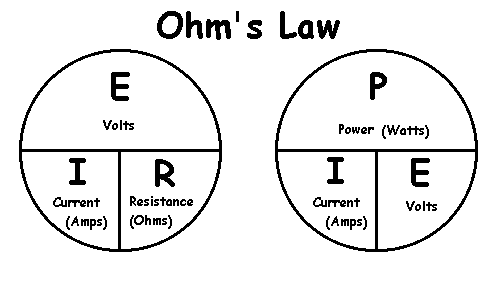
› 11678665 › Ohms_Law_and_Kirchhoff(DOC) Ohm's Law & Kirchhoff's Law Lab Report - Academia.edu Ohm’s Law can be used to solve simple circuit’s resistive electronic circuits. Ohm’s Law is given by: V=IR Where “V” is equal to voltage between two points which include resistance “R” and “I” is the current flowing through resistance. Ohm's Law, Ohm's Law Pie Chart - the12volt.com Ohm's Law defines the relationships between (P) power, (E) voltage, (I) current, and (R) resistance. One ohm is the resistance value through which one volt will maintain a current of one ampere.
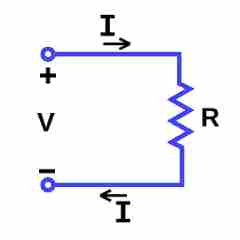
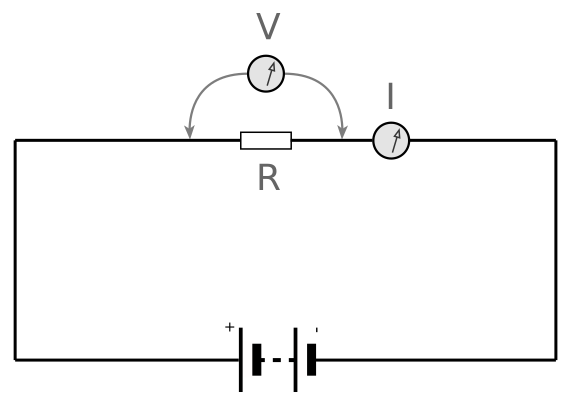
Ohm's law circuit diagram [How to Read Symbols] • Ohm Law Ohm's law circuit diagram [How to Read Symbols] The simple Ohm's Law Circuit Diagram comprises a resistance connected in series with a DC voltage source. Two parallel lines having one with comparatively larger length represents the DC Source and a Zig-Zag symbol represents the resistor. Whereas the simple lines are used to represent the wires.

Ohm's law diagram
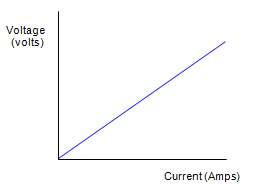
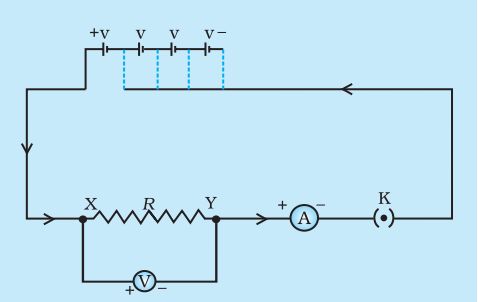
Ohm's Law - Heat and Sensor Technology Ohm's Law Diagram. Click the image for an Ohms Calculator. Ohm's law is named after the German physicist Georg Ohm. Georg published his work in 1827. Georg's proven work states that a current moving through a conductor and between two points, is directly proportional to the potential difference spanning across the two points. Introducing ... ohm's law diagram.png - Ohm's Law HELP Select the metal ... View ohm's law diagram.png from PHY 098 at Universiti Teknologi Mara. Ohm's Law HELP Select the metal: Show circuit diagram Silver Length of the wire:20cm 10 100 Diameter of the wire: State Ohm's law. Draw a labelled circuit diagram to verify ... Circuit diagram for Ohm's law : Explanation : If a graph is drawn between the potential difference (V) and current (I), the graph is found to be a straight line passing through the origin. This shows that the current is directly proportional to the potential difference.
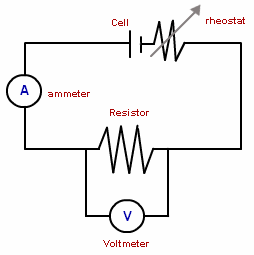
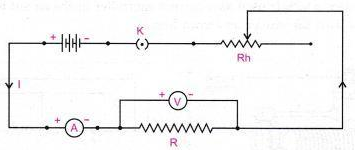
Ohm's law diagram. Verification of Ohm's Law experiment with data and graph ... Fig. (1) gives the circuit diagram for the verification of Ohm's Law lab experiment. Circuit Diagram for Ohm's Law Experiment. Here, R is the resistance of the wire, A is the ammeter, V is the Voltmeter, Rh is the rheostat and K is a key. Arrow sign indicates the direction of current flow in the circuit. Ohms Law Calculator Simple to use Ohm's Law Calculator. Calculate Power, Current, Voltage or Resistance. Just enter 2 known values and the calculator will solve for the others. Diagram For Ohm's Law - U Wiring Diagram for ohm's law. Three quantities which are fundamental to electric circuits are current voltage potential difference and resistance. Ohms law states that Current through a conductor is directly proportional to voltage difference across it. I VR V IR R VI where. Since the resistors are ohmic and we are given the voltage across the cell ... IC 7408 Pin Diagram, Circuit Design, Data Sheet ... - ETechnoG IC 7408 is a logic gate IC. It consists of four two-input AND Gates. The IC 7408 has total fourteen pins including ground and Vcc. The simple pin diagram is shown here. The internal structure of IC 7408 described here. Pin Description of IC 7408 explained in detail. Application of IC …
Ohm's Law Lab Report [With Graph, Observations and ... Ohm's Law Lab Report [With Graph, Observations and Verification] February 20, 2018 February 20, 2018 admin. Ohm's law is the fundamental law of Electrical Engineering. It relates the current flowing through any resistor to the voltage applied to its ends. According to the statement: The current flowing through a constant resistor is ... Physics Tutorial: Ohm's Law and the V-I-R Relationship R = ΔV / I = (6 V) / (1 A) = 6 Ω. Diagram B: R = ΔV/ I = (6 V) / (2 A) = 3 Ω. The resistance is greatest in the circuit with the least current - Diagram A. The Ohm's law equation is often explored in physics labs using a resistor, a battery pack, an ammeter, and a voltmeter. An ammeter is a device used to measure the current at a given ... Ohm's Law Practice Worksheet With Answers [PDF Download ... 2019-08-30 · Ohm’s Law is named after George Simon Ohm a German physicist. Ohm performed repeated experiments on a resistor, applied different voltages, measured current and found relationship between these quantities. He finally published the law in 1827 and generalized his observations in single statement: The current flowing through the resistor is directly … eepower.com › resistor-fundamentals › ohms-lawOhm’s Law | Resistor Fundamentals | Resistor Guide Ohm’s law states that the electrical current through a conductor is proportional to the potential difference across it. Furthermore, the electrical resistance of the conductor is constant. This leads to the mathematical equation:
Ohm’s Law Worksheet - Basic Electricity - All About Circuits 2022-02-16 · Draw the schematic diagram for an experimental circuit to gather data necessary to plot the voltage/current graph of a gas discharge lamp. Reveal answer . Notes: One of my goals as a technical educator is to encourage the development of experimentation skills in my students. The most accurate way to gain knowledge of a device’s operation or of an electrical principle is … 11.2 Ohm's Law | Electric circuits | Siyavula 11.2 Ohm's Law (ESBQ6) Interactive Exercise 11.2. Try the interactive questions. Three quantities which are fundamental to electric circuits are current, voltage (potential difference) and resistance. To recap: Electrical current, I, is defined as the rate of flow of charge through a circuit. Potential difference or voltage, V, is the amount of ... PDF Ohm 's Law - Oakton Community College 3-1—3-3: Ohm 's Law Formulas There are three forms of Ohm's Law: I = V/R V = IR R = V/I where: I = Current V = Voltage R = Resistance Fig. 3-4: A circle diagram to help in memorizing the Ohm's Law formulas V = IR, I = V/R , and R= V/I . The V is always at the top. Ohm's Law - Definition, Formula, Applications of Ohm's Law ... Ohm's law states that the voltage or potential difference between two points is directly proportional to the current or electricity passing through the resistance, and directly proportional to the resistance of the circuit.The formula for Ohm's law is V=IR.This relationship between current, voltage, and relationship was discovered by German scientist Georg Simon Ohm.
Ohm's Law and Resistance - Miss Wise's Physics Site
What is Ohm's Law? Explanation, Formula and Solved Example Ohm’s law can be used to simplify and analyze both basic and complex electric circuits. There are multiple versions and equations used to find the values of different quantities such as electric current, voltage and resistance of the circuit. Ohm’s law can be applied on a part or whole circuit at once. If applied on a whole electric circuit, the total voltage is divided by the total ...

Ohm's Law for AC
Ohm's Law Statement, Verification Experiment, Derivation ... Ohm's Law states: The potential drop across a resistor is proportional to the current passing through the resistor: V ∝ I. Ohm's Law applies only to resistors with constant resistance; that is, to resistors whose resistance is the same no matter what current is passing through them.For such resistors: V/I =R (where R is constant). Ohm's Law can be written: V = IR (where R is constant).

Ohm's Law Animation - Ohm Law - Ohm's Law Simulation - Ohm's Law Formula and Definition - PhET Sim
Voltage Drop Formula & Example Calculation - Electrical4U 2012-02-24 · Voltage drop is calculated through Ohm’s law. Voltage Drop in Direct Current Circuits. In direct current circuits, the reason for voltage drop is resistance. For understanding the voltage drop in the DC circuit, let’s look at an example. Assume a circuit that consists of a DC source, 2 resistors that are connected in series, and a load. Here, every element of the circuit …
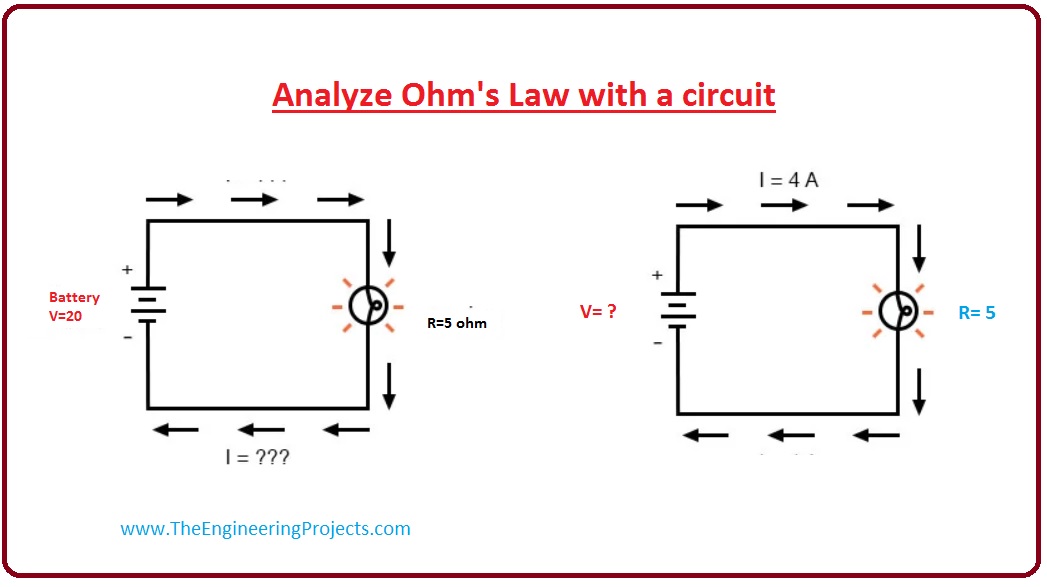
What is Ohm's Law - The Engineering Projects
Ohm's Law | Basic Concepts and Test Equipment ... Use of Ohm's Law . SCHEMATIC DIAGRAM . ILLUSTRATION . INSTRUCTIONS. Select a resistor from the assortment, and measure its resistance with your multimeter set to the appropriate resistance range. Be sure not to hold the resistor terminals when measuring resistance, or else your hand-to-hand body resistance will influence the measurement!

Draw a circuit diagram to verify ohm's law .
en.wikipedia.org › wiki › Ohm&Ohm's law - Wikipedia Ohm's law states that the current through a conductor between two points is directly proportional to the voltage across the two points. Introducing the constant of proportionality, the resistance, one arrives at the usual mathematical equation that describes this relationship: =, where I is the current through the conductor in units of amperes, V is the voltage measured across the conductor in ...
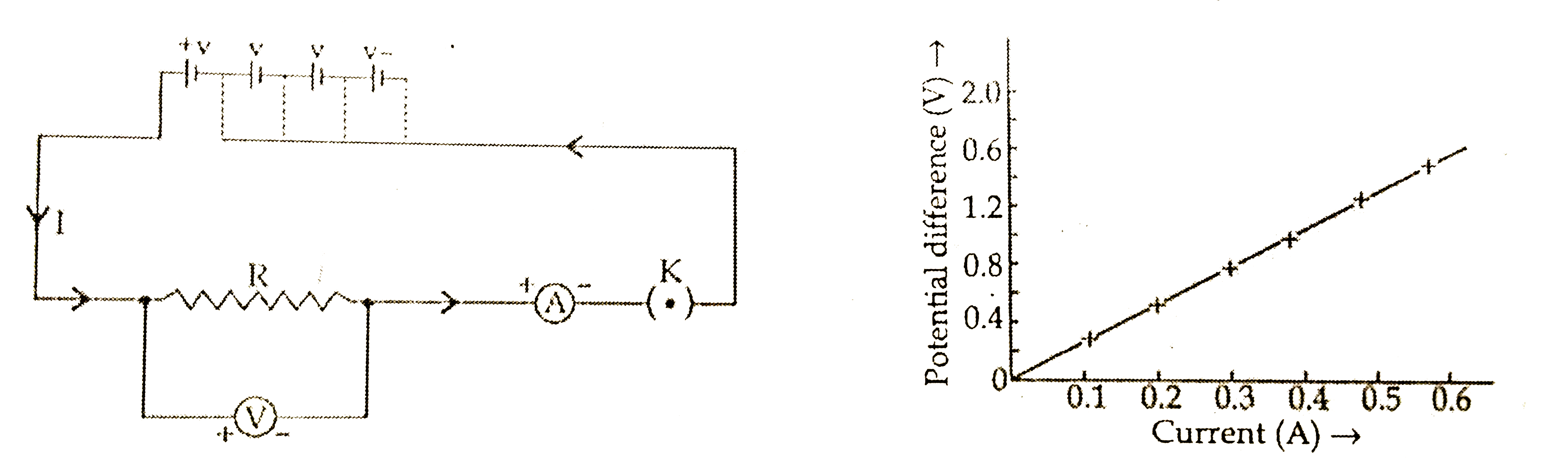
State Ohm's law. Draw a labelled circuit diagram to verify ...
What Is Ohms Law Formula - AnswersData What is Ohm's law with diagram? Ohm's law states that Current through a conductor is directly proportional to voltage difference across it. where V is the voltage, I is the current and R is the resistance. The circuit diagram to verify ohm's law is drawn below. Voltmeter across a resistor is connected in parallel.
Physics for Kids: Ohm's Law
web.pa.msu.edu › courses › 2014springOhm’s Law - Michigan State University Jan 24, 2013 · Ohm’s Law 2.1 Objectives • Become familiar with the use of a digital voltmeter and a digital ammeter to measure DC voltage and current. • Construct a circuit using resistors, wires and a breadboard from a circuit diagram. • Construct series and parallel circuits. • Test the validity of Ohm’s law.
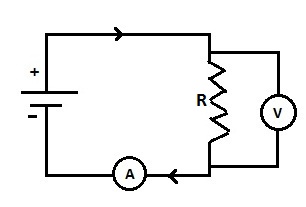
1. Draw a diagram based on Ohm's law of what you would expect ...
Ohms Law Calculator Related: resistor calculator Ohm's Law. Ohm's Law states that the current through a conductor between two points is directly proportional to the voltage. This is true for many materials, over a wide range of voltages and currents, and the resistance and conductance of electronic components made from these materials remain constant.

Ohm's Law: Diagram, Equation & Experiment – StudiousGuy
State Ohms law Draw a graph between voltage and current ... Ohm's law gives a relation between the current, resistance, and voltage in a circuit. According to ohm's law, the current flowing between two points is directly proportional to the voltage difference between those two points. This means more is the voltage difference, more is the current flow between these points. This can be represented as,
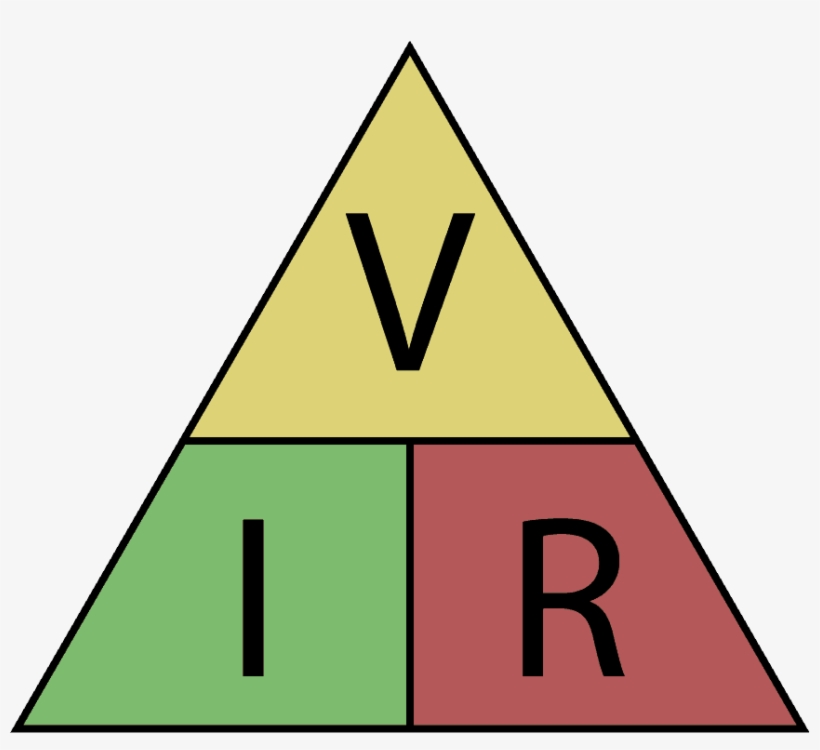
Ohms Law Triangle - Diagram Used For Remembering Ohm's Law ...
State Ohm's Law With Diagram - U Wiring State Ohm S Law Draw A Circuit Diagram To Verify This Indicating The Positive And Negative Brainly In. This can be represented as. Solution first we use ohms law to determine the value of iy. —- Derivation of Equivalent resistance 1 Equivalent resistance in Series combination. Voltage Current and ResistanceVoltage is the amount of energy ...

Metabolic Ohm's Law (A) A schematic diagram explaining why ...
Ohm's Law with Examples - problemsphysics.com Solution to Example 1. Substitute R by 2 and V by 6 in Ohm's law V = R I. 6 = 2 I. Solve for I. I = 6 / 2 = 3 A. Example 2. In the circuit below resistors R1 and R2 are in series and have resistances of 5 Ω and 10 Ω, respectively. The voltage across resistor R1 is equal to 4 V. Find the current passing through resistor R2 and the voltage ...

Ohm's Law: Diagram, Equation & Experiment – StudiousGuy
Ohm's Law: Diagram, Equation & Experiment - StudiousGuy This is known as Ohm's Law and represented as; In the above equation, R is a constant, and it is referred to as resistance. For a given metallic wire, R is constant at a given temperature. According to Ohm's law, R=V/I. Also, as per the Ohm's law, the current flowing through a conductor is inversely proportional to the resistance of the ...
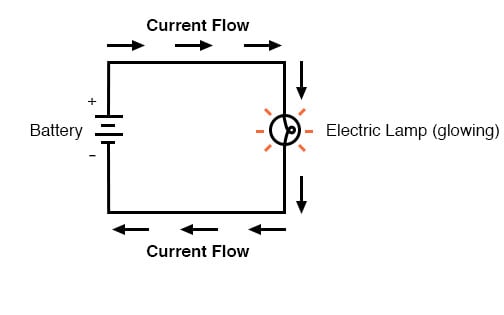
Ohm's Law - How Voltage, Current, and Resistance Relate ...
Quick Answer: What Is Ohms Law Diagram - SeniorCare2Share What is Ohm's law class 10 diagram? OHM's law states that under no same temperature, electric current flowing through an ideal conductor is directly proportional to the potential difference across its ends. Resistance is a property of conductor to resist flow of charge through it. Its SI unit is Ohm (Ω).
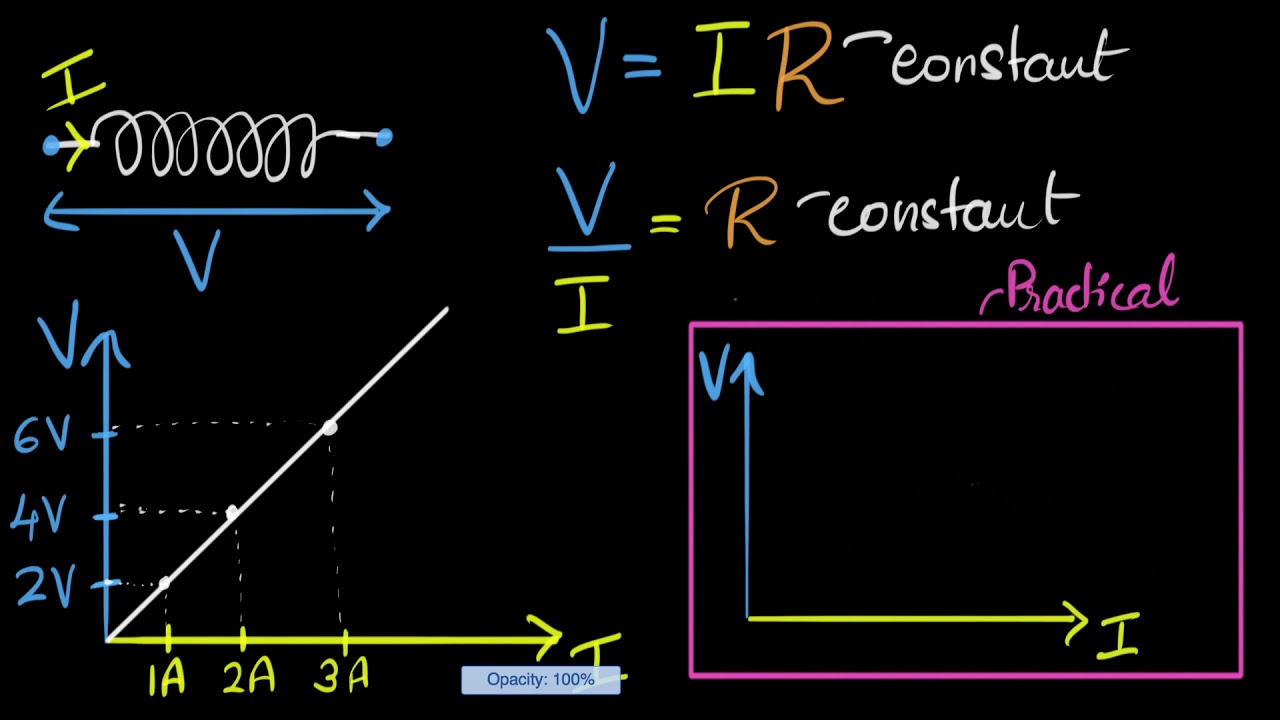
Ohm's law graph (verifying Ohm's law)
Ohms Law Circuit Diagram | EdrawMax Template Understanding Ohms Law Circuit Diagram Ohm's Law only holds if the given temperature and the other physical factors remain constant. In certain elements, increasing the current raises the temperature. An example of this is the filament of a light bulb, in which the temperature rises as the current is increased. In this case, Ohm's Law cannot be ...
schoolphysics ::Welcome::
› ohmslawOhm's Law with Calculator - bcae1.com Ohm's Law. There are 2 base formulae which will help you to understand the relationship between current, voltage, resistance and power.If you have any two of the parameters, you can calculate the other two parameters.

Ohm's Law and V-I graph of various components | Evan's Space
Draw a circuit diagram to verify ohm's law - Toppr Ask The circuit diagram to verify ohm's law is drawn below. Voltmeter across a resistor is connected in parallel. Ammeter to measure current in the circuit is attached in series. A variable resistor is connected. Changing the resistance would alter potential drop across the resistor which would affect the amount of current.
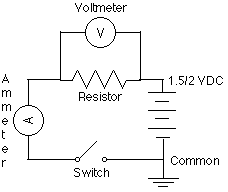
Physics Experiment - Ohm's Law
Ohms Law Class 10: Derivation, Circuit Diagram, V-I Graph ... Ohms Law is an important topic of the electricity chapter for class 10th. Many questions related to this topic such as Ohm's law derivation, formula, Ohms law circuit diagram, graph, limitations of Ohms law, etc are asked in the class tenth board exam.
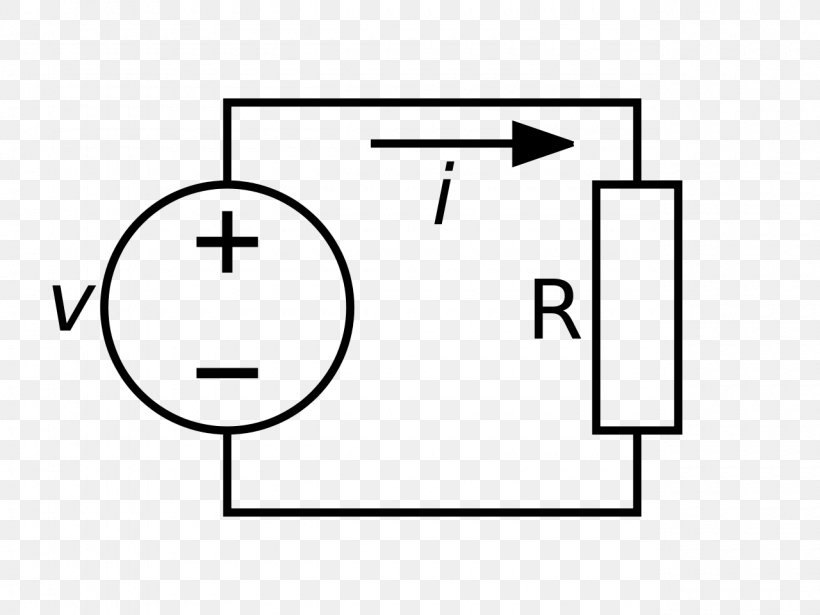
Wiring Diagram Electronic Circuit Ohm's Law LED Circuit ...
ohmlaw.com › ohms-law-calculatorOhm's Law Calculator • Ohm Law - Ohm's Law • Ohm Law Feb 20, 2018 · He finally published the law in 1827 and generalized his observations in single statement: The current flowing through the resistor is directly proportional to the voltage applied across it. The website is a dedicated resource for Ohm’s law, calculation tools, applications and theoretical calculations on Ohm’s law.

What is Ohm's Law? (A Simple Explanation) | Electrical4U
NCERT Class 10 Science Lab Manual - Ohm's Law - CBSE Tuts Ohm's Law Experiment Class 10 Pdf Introduction. Charge: There are two charges in nature i.e., positive and negative. The negative charge is due to electron. Its value is 1.6 x 10 -19 C. It is measured in coulombs. Coulomb: One coulomb is the amount of charge present on 6.25 x 10 18 electrons. Electric Current: It is the rate of flow of charge ...

Ohm's Law
State Ohm's law. Draw a labelled circuit diagram to verify ... Circuit diagram for Ohm's law : Explanation : If a graph is drawn between the potential difference (V) and current (I), the graph is found to be a straight line passing through the origin. This shows that the current is directly proportional to the potential difference.
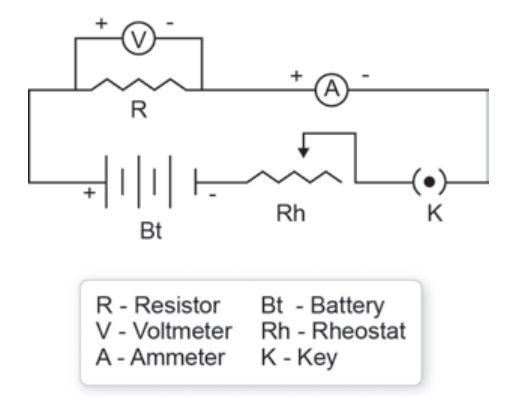
Verification of Ohm's law - Science laboratory practical ...
ohm's law diagram.png - Ohm's Law HELP Select the metal ... View ohm's law diagram.png from PHY 098 at Universiti Teknologi Mara. Ohm's Law HELP Select the metal: Show circuit diagram Silver Length of the wire:20cm 10 100 Diameter of the wire:
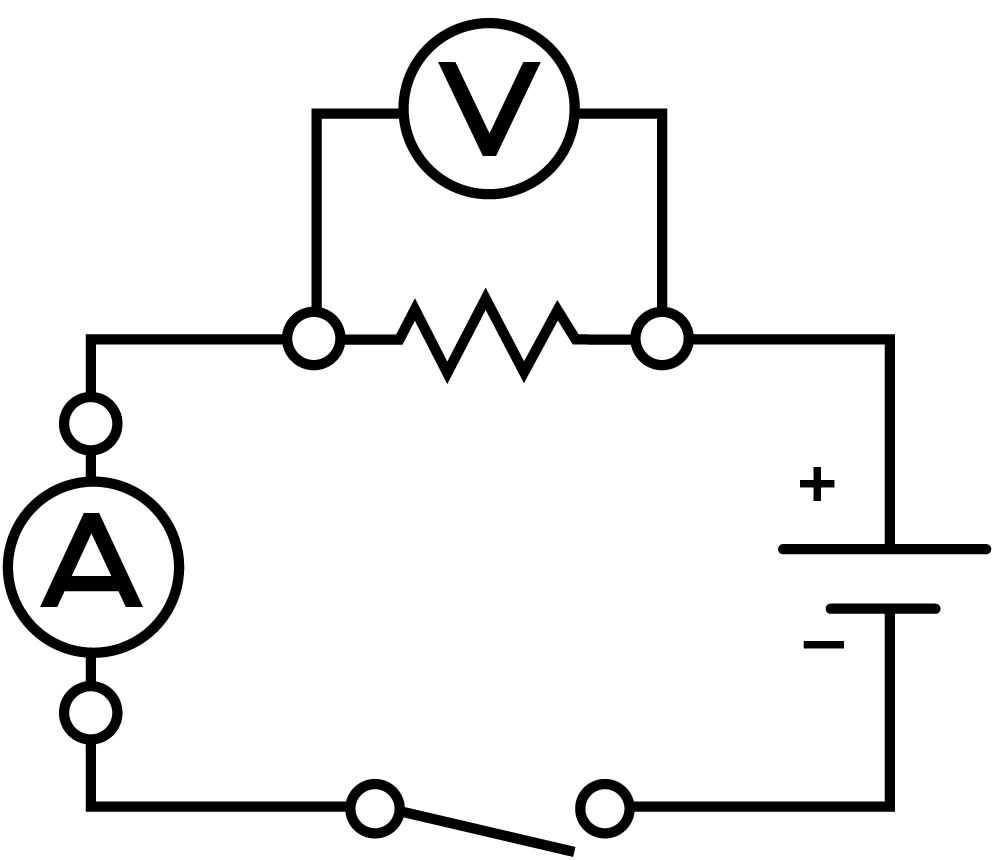
Exploring Ohm's Law | BCHydro Power Smart for Schools
Ohm's Law - Heat and Sensor Technology Ohm's Law Diagram. Click the image for an Ohms Calculator. Ohm's law is named after the German physicist Georg Ohm. Georg published his work in 1827. Georg's proven work states that a current moving through a conductor and between two points, is directly proportional to the potential difference spanning across the two points. Introducing ...
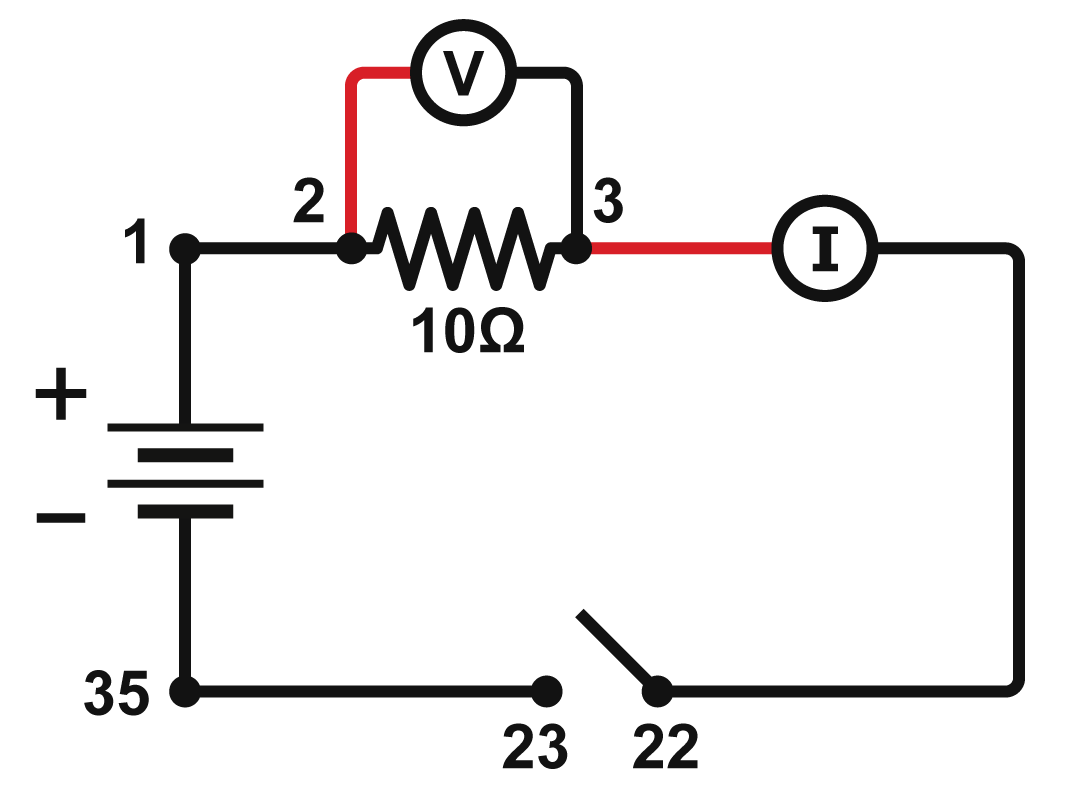
Ohm's Law - Vernier
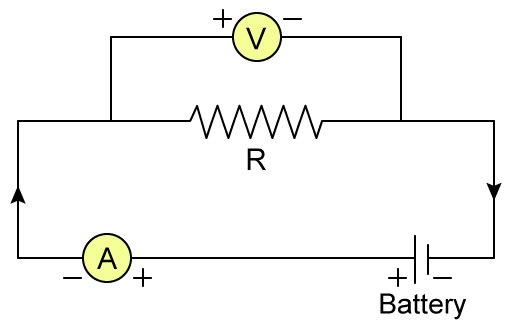
State ohms law draw a circuit diagram to verify ohms law ...

13 Ohms law and I V graphs
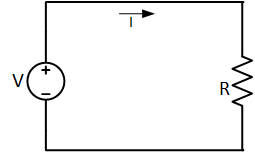
State and Explain Ohm's Law Formula: Ohm's law calculator
What is Ohms Law - formula equation » Electronics Notes
Ohm's Law
Ohm's Law: Diagram, Equation & Experiment – StudiousGuy
State Ohm's law. Express it mathematically. How is it ...
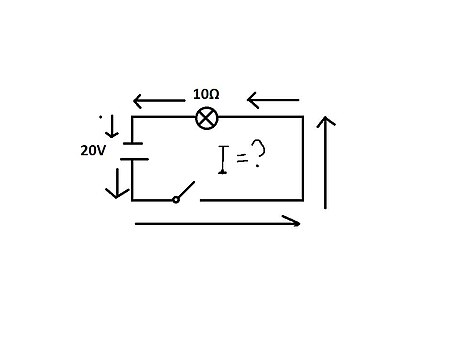
Ohm's law - Simple English Wikipedia, the free encyclopedia
State Ohm's law. Draw a graph between voltage and current for ...

Lesson Explainer: Ohm's Law | Nagwa
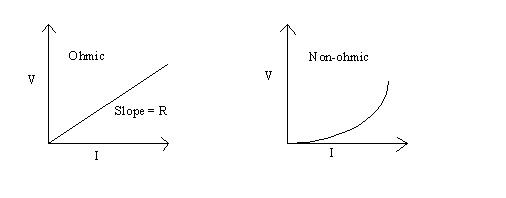
OHM'S LAW and RESISTANCE Name:

11.2 Ohm's Law | Electric circuits | Siyavula
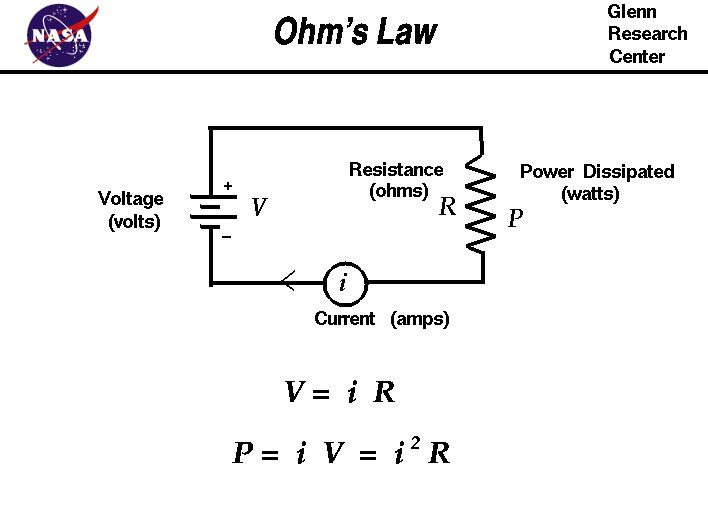
Ohm's Law
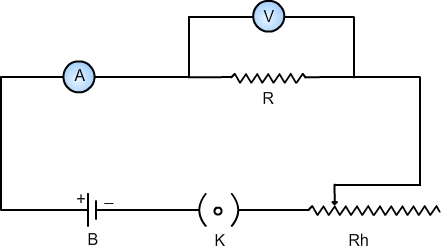
state ohms law and labelled diagram to verify - Science ...
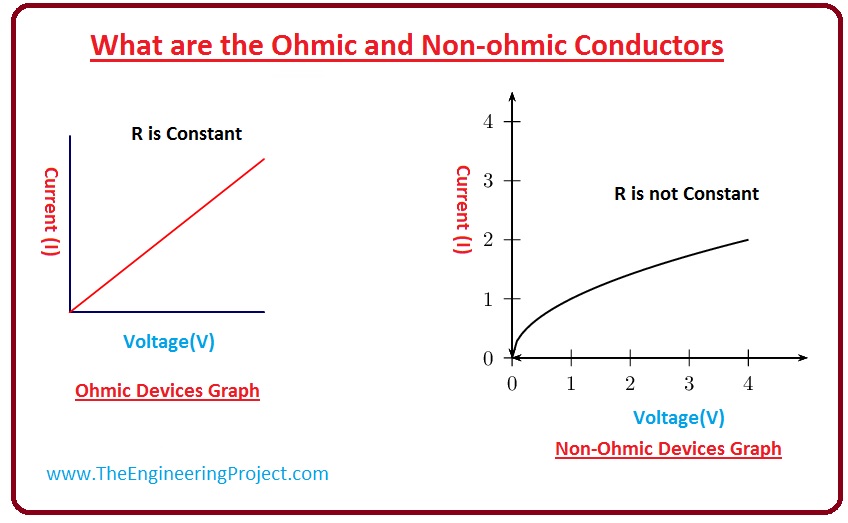
What is Ohm's Law - The Engineering Projects
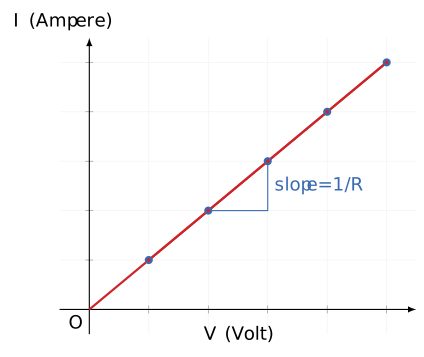
Verification of Ohm's Law using Voltmeter and Ammeter ...

CBSE Class 10 Science Lab Manual - Ohm's Law - A Plus Topper ...


Comments
Post a Comment